Neurological Considerations in Pedestrian Injuries and Motorcycle Collisions
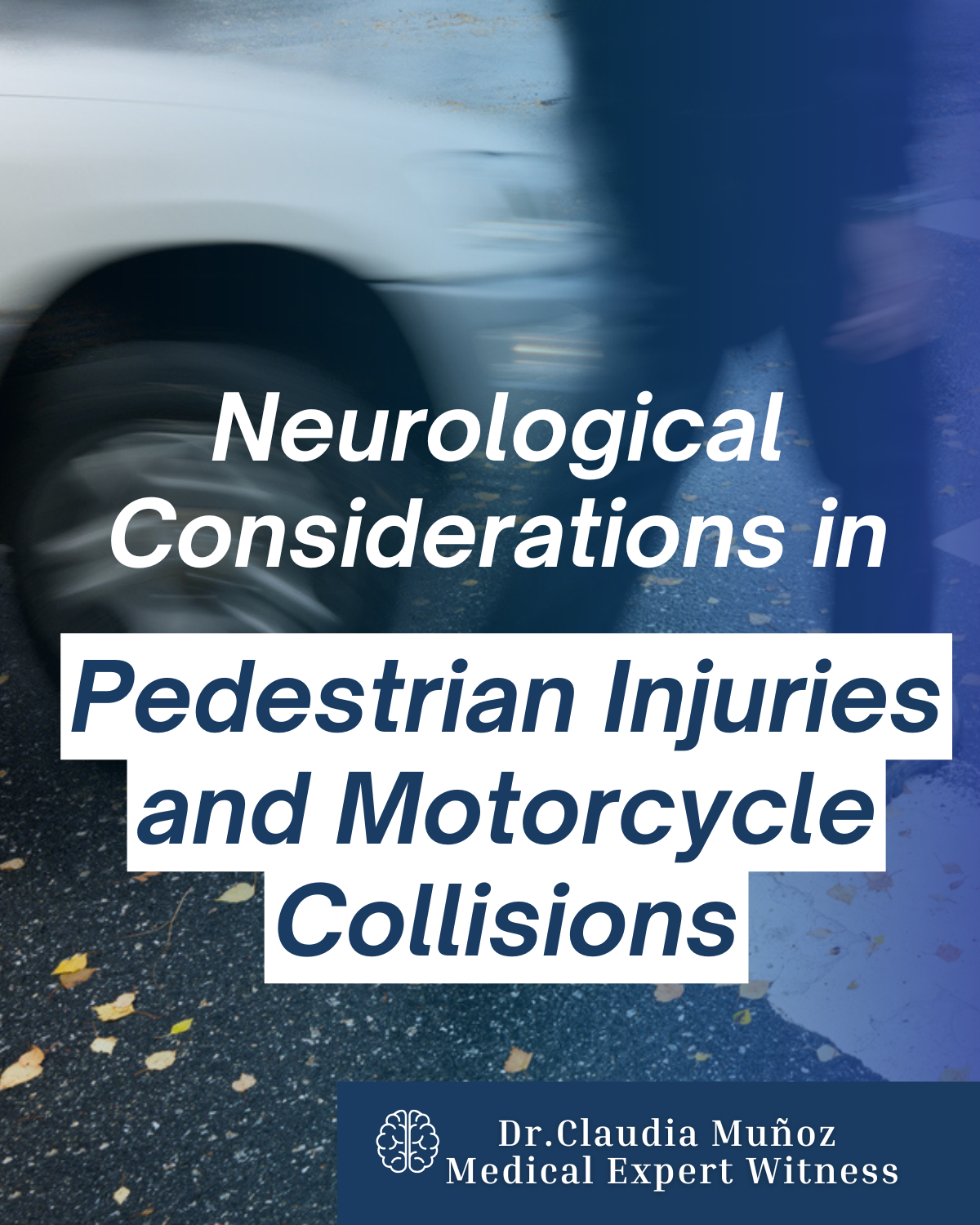
Pedestrian injuries and motorcycle collisions are among the highest-risk mechanisms for traumatic brain injury (TBI) in personal injury litigation. Unlike occupants in enclosed vehicles, pedestrians and motorcyclists are directly exposed to impact forces, often resulting in complex neurological outcomes.
These cases require careful medical evaluation, as the severity of brain injury is not always immediately apparent.
High-Energy Mechanisms and Brain Injury Risk
Both pedestrian impacts and motorcycle crashes frequently involve high-velocity forces, rapid acceleration-deceleration, and rotational movement of the head. These forces can lead to:
Diffuse axonal injury
Contusions or intracranial hemorrhage
Secondary metabolic and cellular dysfunction
Even when protective equipment such as helmets is used, brain injury can still occur due to rotational forces that disrupt neuronal connections.
In many cases, CT scans identify acute injuries such as bleeding or fractures. However, not all traumatic brain injuries are visible on imaging.
Patients may present with:
Cognitive slowing and memory impairment
Headaches and dizziness
Difficulty concentrating
Mental fatigue
Balance and coordination issues
These symptoms may reflect functional and microscopic brain injury, rather than structural damage detectable on routine imaging.
Clinical Evaluation Beyond the Emergency Setting
Initial emergency care focuses on life-threatening injuries, but neurological symptoms may evolve over time. A comprehensive evaluation requires attention to:
Mechanism of injury and force dynamics
Acute neurological findings
Symptom progression
Functional limitations in daily activities
This longitudinal perspective is critical in understanding the true impact of the injury.
Medico-Legal Challenges in These Cases
Pedestrian and motorcycle cases often involve complex legal questions, including:
Disputed mechanisms of injury
Variability in witness accounts
Severity of impact vs reported symptoms
Long-term functional impairment
In some cases, imaging findings may not fully explain the extent of symptoms. In others, symptoms may appear disproportionate to the documented mechanism. These scenarios require careful, objective analysis.
The Role of the Neurologist Expert Witness
As a neurologist and medical expert witness, my role is to provide evidence-based, clinically grounded opinions that assist legal teams in understanding:
Whether the mechanism of injury is sufficient to cause TBI
Whether symptoms are consistent with known neurological patterns
The severity and expected course of the injury
The relationship between the accident and long-term impairment
This analysis integrates medical records, imaging, clinical findings, and established neuroscience to support clear and defensible conclusions.
Why Neurological Expertise Matters
In high-impact cases such as pedestrian injuries and motorcycle collisions, the absence of obvious findings does not necessarily indicate the absence of brain injury. Conversely, not all reported symptoms are always directly attributable to the event.
Accurate neurological interpretation helps ensure that conclusions are based on medical science, not assumptions, providing clarity for attorneys, insurers, and courts.
📩 For inquiries or medical expert witness consultations, please contact me using the form below or directly at:
Dr. Claudia
Neurologist | Medical Expert Witness
Traumatic Brain Injury & Neurological Cases
