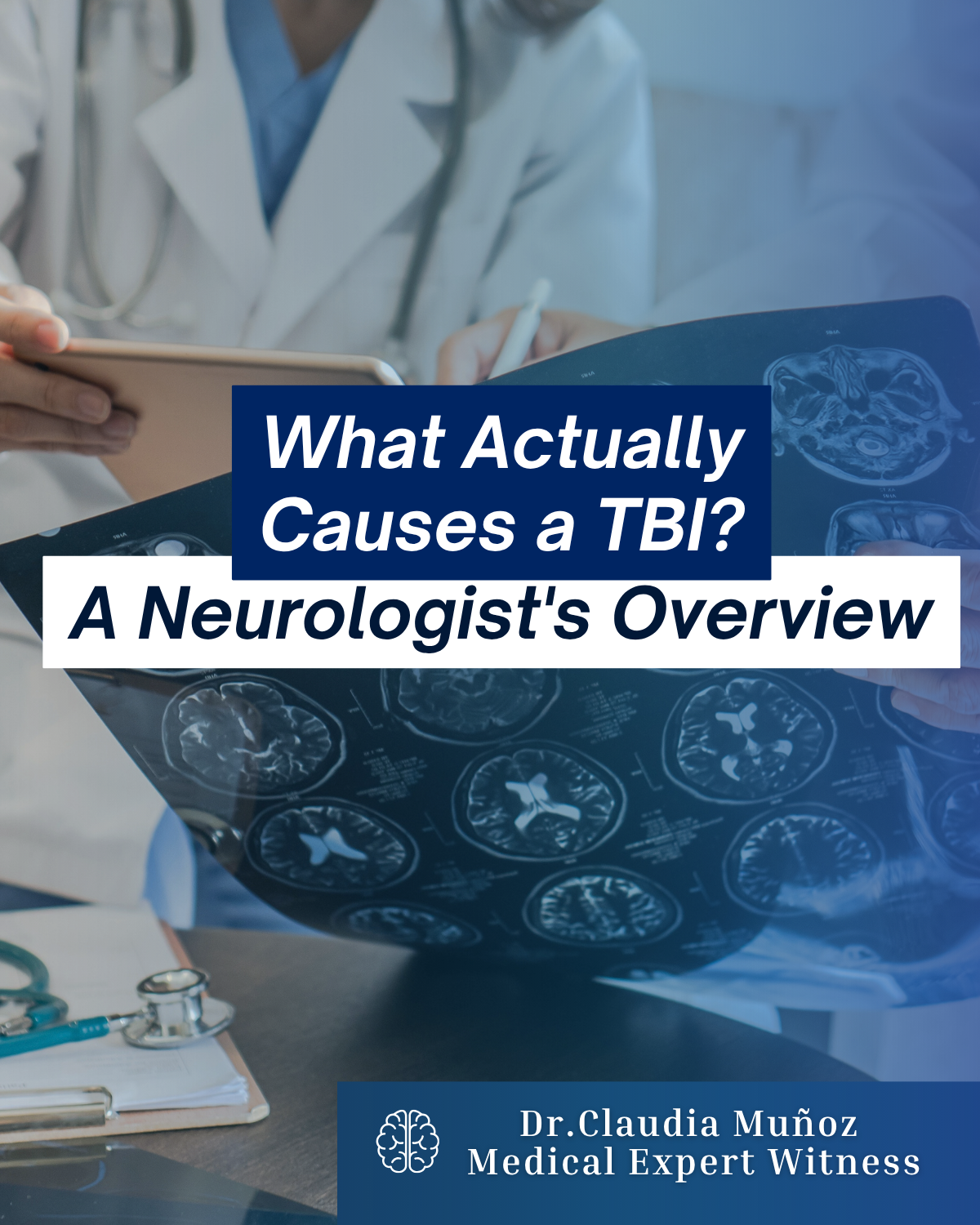
What Actually Causes a TBI? A Neurologist's Overview
By Dr. Claudia Munoz, MD, MPH — Board-Certified Neurologist & Epileptologist, Medical Expert Witness
Before evaluating the severity, symptoms, or long-term impact of a traumatic brain injury, it helps to start with the basics: what a TBI actually is, and how it happens. Understanding the underlying mechanism is often the foundation for everything else in a case evaluation.
What Is a Traumatic Brain Injury?
A traumatic brain injury is an injury that disrupts normal brain function. It's defined by the mechanism of injury and its effect on the brain — not by the presence or absence of visible trauma, and not by whether the person lost consciousness.
TBI generally results from one of three mechanisms:
Blunt force injury. A bump, blow, or jolt to the head — from a fall, a car accident, a sports injury, or an assault, among other causes. Importantly, the head does not need to strike an object directly. Rapid acceleration or deceleration, such as in a car accident, can cause the brain to move forcefully within the skull, resulting in injury even without direct impact.
Penetrating injury. An object entering the skull and brain tissue directly, such as from a gunshot wound. These injuries tend to cause more localized, focal damage compared to the more diffuse injury patterns often seen in blunt force trauma.
Blast injury. Exposure to an explosive pressure wave — most commonly in military or occupational settings — that transmits energy through the skull and brain tissue. These injuries can produce diffuse brain damage even without direct physical contact or visible external trauma, and are frequently underrecognized in clinical and legal contexts.
Recognizing which mechanism is involved — and understanding that a TBI doesn't require a direct hit to the head — is often a key starting point in evaluating whether a claimed injury is medically plausible.
Once the mechanism is established, TBI is generally classified into three levels of severity:
Mild TBI (concussion). The most common classification, generally involving brief or no loss of consciousness and normal or near-normal initial imaging. Despite the "mild" label, some patients develop persistent symptoms lasting weeks, months, or longer.
Moderate TBI. Typically involves a longer period of loss of consciousness and more pronounced findings on initial evaluation, often with visible abnormalities on imaging. Recovery outcomes vary considerably within this category.
Severe TBI. Generally involves prolonged loss of consciousness, substantial imaging findings, and a high likelihood of lasting cognitive, physical, or behavioral impairment, often requiring extensive long-term care.
It's worth noting that severity classification reflects the initial presentation of the injury — it is not a reliable predictor of long-term outcome, particularly for mild TBI.
Mechanism informs plausibility. Understanding how a specific type of injury typically occurs helps establish whether a claimed TBI is consistent with the incident described — whether that's a fall, a car accident, or another cause.
Classification is a starting point, not a conclusion. A "mild" or "moderate" label describes the initial injury, not necessarily the trajectory of recovery or the case's eventual value.
Absence of direct head impact doesn't rule out TBI. This is one of the most commonly misunderstood points in litigation — acceleration-deceleration forces alone can cause significant brain injury.
As always, the specific facts of a case — mechanism, force, medical history, and clinical presentation — determine the applicable analysis. This article provides a general clinical overview, not an opinion on any specific case.
Whether a case involves a straightforward concussion or a more complex mechanism of injury, a thorough neurological evaluation helps establish the nature and extent of the injury from the ground up.
I provide independent medical examinations, medical record review, expert report writing, and deposition and trial testimony for plaintiff and defense attorneys handling TBI cases across the full spectrum of causes and severity.
📩 doctor.claudia@gmail.com | info@drclaudiamunoz.com
Dr. Claudia Munoz, MD, MPH
Neurologist | Epileptologist | Medical Expert Witness
#TraumaticBrainInjury #TBI #MedicalExpertWitness #Neurology #ForensicNeurology #LitigationSupport #PersonalInjuryLaw
