By Dr. Claudia Muñoz, MD, MPH — Board-Certified Neurologist & Epileptologist, Medical Expert Witness
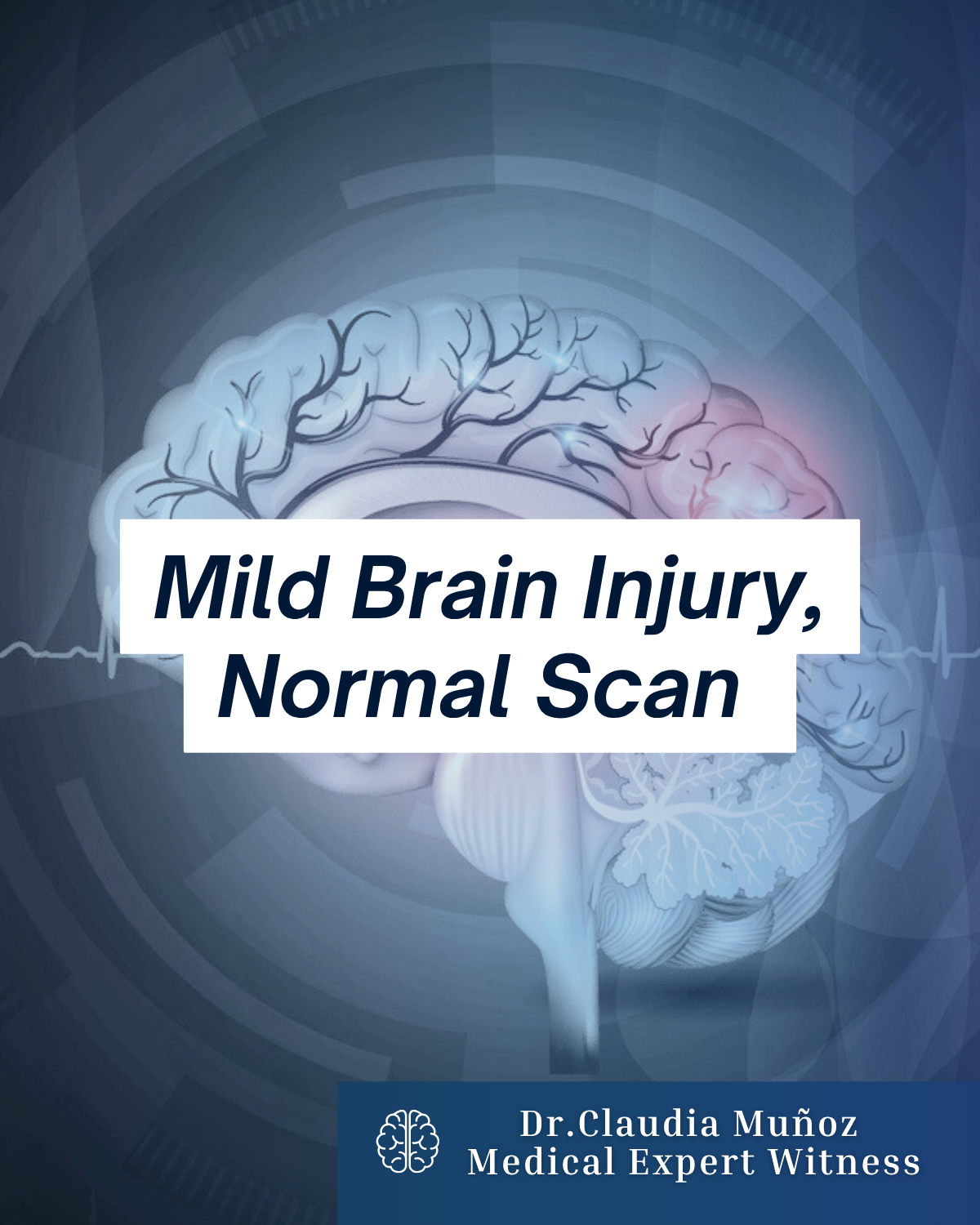
“The scan was normal” is one of the most common statements in mild traumatic brain injury (TBI) cases. It is also one of the most misunderstood. A normal CT or MRI is a real finding, but it answers a narrow question: is there damage large enough to see? It does not answer whether the brain was injured or how it is functioning.
Recent research on repeated head impacts helps explain why.
Why Scans Are Often Normal in Mild TBI
CT and MRI are built to find structural problems such as bleeding, swelling, and contusions. Mild TBI, including concussion, is largely a functional injury. The brain’s cells and connections can be disrupted without producing changes that routine imaging can detect. In everyday practice, that means:
A normal scan does not rule out a mild TBI.
A normal scan does not confirm one either.
Diagnosis rests on the mechanism, the symptoms and their timeline, the exam, and, where appropriate, neuropsychological testing.
What the NIH-Reported Research Adds
A 2025 study in Nature, summarized by the National Institutes of Health, examined brain tissue after death from 28 men aged 20 to 51. One group had not played contact sports. One group had played football or soccer without a diagnosis of chronic traumatic encephalopathy (CTE). One group had played contact sports and had low-stage CTE.
In the tissue examined, the researchers found:
More inflammatory immune cells in athletes who played contact sports, with or without CTE
Changes in gene activity in the brain’s blood vessels
Lower neuron density in the examined brain regions of contact-sport athletes, which fell further with more years of play
Neuron loss that did not track with levels of p-tau, the protein associated with CTE, suggesting the cell changes may begin before that protein builds up
The authors concluded that athletes without CTE can still show substantial changes in the brain after repeated head impacts.
What This Research Does Not Show
These findings are important, and they have clear limits. A careful reading matters in either direction:
Small sample, and a specific population. Twenty-eight men, studied after death. The findings cannot be applied to any one person.
Not a diagnostic test. The changes were found in tissue under the microscope. They cannot yet be detected in a living person, and the study did not look at imaging, symptoms, or cognitive testing.
Association, not individual causation. The work describes group patterns in athletes. It does not establish that a particular head impact caused a particular person’s symptoms.
Further research is needed. The authors themselves note that more studies in more people are required.
What This Means for Case Evaluation
A normal scan is not the end of the analysis. Microscopic injury may exist that imaging cannot show. Equally, a normal scan does not prove injury occurred.
Repeated impacts deserve careful history-taking. Prior sports, military, or occupational head impacts can bear on both the baseline and the current picture.
Clinical evidence carries the weight. A consistent mechanism, symptom timeline, exam findings, and testing results matter more than any single image.
Research findings need to be applied carefully. Group-level science supports general principles. It does not substitute for an individual evaluation.
Each case depends on its specific facts and medical history. This article summarizes general research findings, not an opinion on any specific case.
Work With a Neurologist Expert Witness
If you are handling a case where the imaging is normal but symptoms persist, or where prior head impacts are part of the history, a thorough neurological review can clarify what the evidence does and does not support.
I provide independent medical examinations, medical record review, expert report writing, and deposition and trial testimony for plaintiff and defense attorneys handling traumatic brain injury cases.
📩 doctor.claudia@gmail.com | info@drclaudiamunoz.com
Dr. Claudia Muñoz, MD, MPH
Neurologist | Epileptologist | Medical Expert Witness
Source: National Institutes of Health, NIH Research Matters, “Effects of repeated head trauma in young athletes,” summarizing Butler MLMD et al., Nature, 2025.
#TraumaticBrainInjury #TBI #Concussion #MildTBI #MedicalExpertWitness #NeurologistExpertWitness #ForensicNeurology #LitigationSupport
