A “Normal” MRI Does Not Mean a Normal Brain Diffuse Axonal Injury in Traumatic Brain Injury Cases
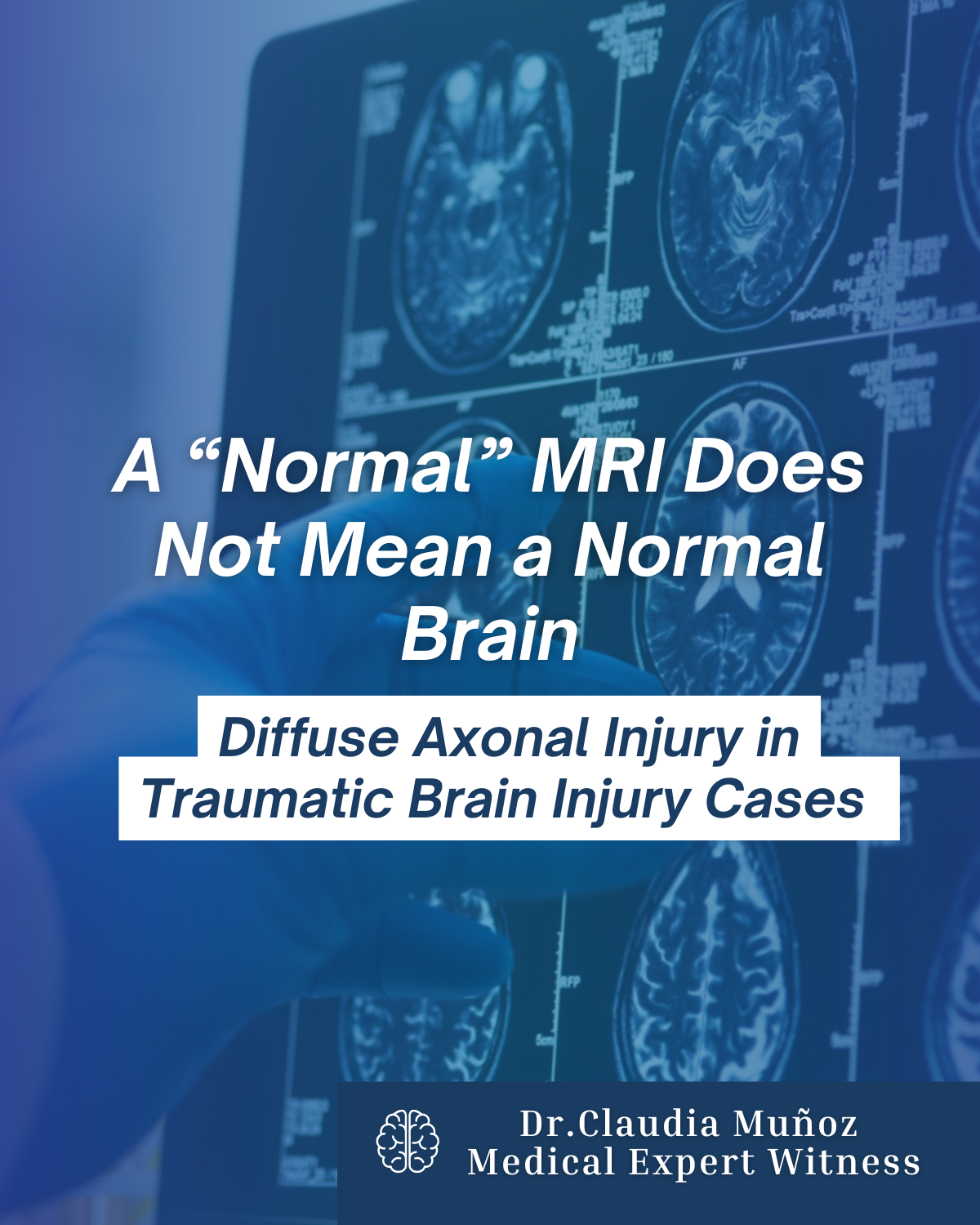
One of the most consequential—and frequently misunderstood—findings in traumatic brain injury (TBI) is often not visible at all.
Diffuse axonal injury (DAI), a common form of brain injury, involves the microscopic shearing of nerve fibers resulting from rapid acceleration-deceleration and rotational forces. Despite its clinical significance, DAI is typically undetectable on standard CT scans and conventional MRI studies.
This limitation has profound implications, particularly in the context of litigation.
In clinical practice, it is not uncommon for a patient to present to the emergency department following a head injury and undergo imaging that is reported as “normal.” No hemorrhage. No fracture. No structural abnormality.
From a radiographic standpoint, the findings appear reassuring.
However, the clinical reality may be markedly different.
Patients may subsequently experience:
Difficulty with concentration and attention
Memory impairment
Cognitive slowing
Emotional or behavioral changes
Persistent mental fatigue
These symptoms reflect disruption of neural connectivity and brain function, not structural damage visible on routine imaging.
The disconnect between imaging findings and clinical presentation often becomes a central issue in legal cases.
In many instances, the absence of visible abnormalities is interpreted as evidence that no injury occurred. This assumption, while understandable, is not supported by current neurological science.
Standard CT and MRI were designed to identify gross structural abnormalities, such as bleeding, fractures, or mass lesions. They are not capable of detecting the microscopic axonal damage that characterizes diffuse axonal injury.
More advanced imaging techniques, such as diffusion tensor imaging (DTI), may provide additional insight into white matter integrity. However, even these modalities have limitations and must be interpreted within the broader clinical context.
For this reason, the diagnosis and evaluation of traumatic brain injury remain fundamentally clinical processes.
A comprehensive neurological assessment considers:
The mechanism of injury, including acceleration and rotational forces
The timing and progression of symptoms
The consistency of clinical findings with established patterns of brain injury
The exclusion of alternative or contributing conditions
In the medico-legal setting, this distinction is critical.
The absence of findings on conventional imaging does not equate to the absence of injury. Rather, it reflects the limitations of the diagnostic tools being used.
This gap between what is measurable on imaging and what is occurring at a functional level in the brain is one of the most significant sources of misunderstanding in traumatic brain injury litigation.
It affects how cases are evaluated, how evidence is interpreted, and ultimately, how decisions are made.
Accurate interpretation requires an understanding that extends beyond imaging findings to include biomechanics, neurophysiology, and clinical presentation.
As a neurologist and medical expert witness, my role is to provide objective, evidence-based analysis that bridges this gap—clarifying whether the reported symptoms are consistent with the mechanism of injury and known neurological principles.
In cases where imaging does not fully explain the clinical picture, careful neurological evaluation becomes essential.
📩 For case-specific analysis, expert reports, or testimony in traumatic brain injury litigation, please contact:
doctor.claudia@gmail.com
info@drclaudiamunoz.com
Dr. Claudia
Neurologist | Medical Expert Witness
Traumatic Brain Injury & Neurological Cases
